
João Moutinho's net worth is estimated at approximately $14 million (around €13 million) as of mid-2026. That figure reflects roughly two decades of professional football across Sporting CP, FC Porto, AS Monaco, Wolverhampton Wanderers, and Rayo Vallecano, combined with endorsement income and the kind of careful financial profile you'd expect from a player who spent years in Portugal's elite and then moved into the Premier League in his early thirties.
João Moutinho Net Worth 2026: Estimated USD & EUR Breakdown

Rafael Pereira
24 Jul 2026
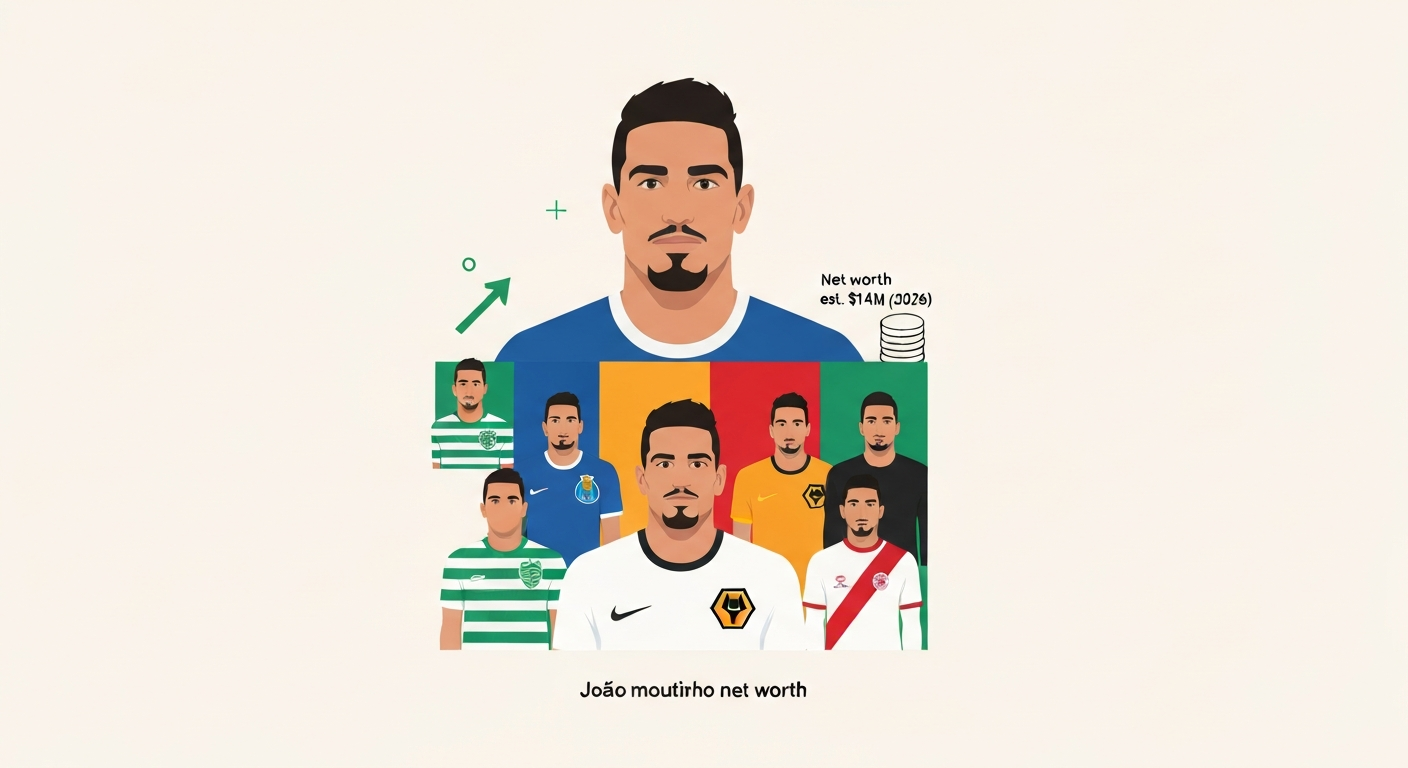
Net worth snapshot (2026)
| Metric | Figure | Notes |
|---|---|---|
| Estimated net worth (USD) | ~$14 million | Mid-2026 estimate |
| Estimated net worth (EUR) | ~€13 million | Mid-2026 estimate, approximate EUR/USD conversion |
| Confidence range (USD) | $10m – $18m | Low end assumes conservative salary and limited bonuses; high end includes higher bonus triggers and undisclosed commercial income |
| Year stamped | 2026 | Last reviewed July 2026 |
| Primary income source | Club salaries (career total) | Spanning Sporting, Porto, Monaco, Wolves, Rayo Vallecano |
| Secondary income source | Endorsements / sponsorships | Nike, national team partnerships (estimated, not publicly declared |
Who is João Moutinho? A quick financial profile
João Filipe Iria Santos Moutinho, born September 8, 1986 in Portimão, Portugal, is a defensive and central midfielder who built his fortune steadily through sustained elite-level performance rather than a single blockbuster contract. His career earnings are anchored by a decade-plus at clubs with serious wage budgets: FC Porto (Champions League regulars), AS Monaco (Ligue 1 top-ten spenders), and Wolverhampton Wanderers (Premier League). He won the UEFA European Championship with Portugal in 2016 and the UEFA Nations League in 2019, both of which generated prize-money distributions to the national federation and boosted his commercial value at the time. His net worth, while below the Ronaldo-tier stratosphere, is comfortably that of a long-serving European professional who avoided financial instability and consistently commanded wages in the top percentile of Portuguese football.
Career biography and income timeline
Moutinho's professional life breaks into five clear phases, each of which corresponds to a different income band. Understanding those phases is the only reliable way to reconstruct his career earnings, because his salary was never publicly disclosed in full by any of his clubs.
Sporting CP (2004–2010)
Moutinho broke through at Sporting CP in Lisbon, making his first-team debut in 2004 and establishing himself as one of the best midfielders in the Primeira Liga by his early twenties. Portuguese top-flight salaries at the time were modest by European standards. Estimates drawn from Capology's historical data and reported by Portuguese sports media place his peak Sporting wage in the range of €10,000–€25,000 per week gross, which translates to roughly €520,000–€1.3 million per year before tax. Over his six years at the club, including youth wages in his debut season, his gross Sporting earnings likely totalled €4–6 million. A €11 million transfer to FC Porto in 2010 (as reported by FootballTransfers and Transfermarkt) confirmed his market value had climbed sharply.
FC Porto (2010–2013)
Porto was the turning point for Moutinho's wage profile. The club was a regular Champions League participant and had the budget to match. Capology estimates his Porto wages at approximately €35,000–€50,000 per week gross during this period. Porto won the UEFA Europa League in 2010/11 and reached the Champions League quarter-finals in 2011/12 and 2012/13, which meant Moutinho participated in UEFA competition bonus cycles. Champions League group-stage and knockout distributions to clubs in those seasons were significant: UEFA's financial distribution framework routes prize money to clubs, not directly to players, but club-level prize income at Porto almost certainly underpinned wage renewal capacity. His three-year gross earnings at Porto are estimated at €5–8 million.
AS Monaco (2013–2018)
The Monaco chapter is the most financially complex. On May 24, 2013, Monaco signed both Moutinho and James Rodríguez from Porto in a combined deal reported by The Guardian at €70 million, with Moutinho's portion widely placed at approximately €25 million. Transfer fees are paid between clubs and do not flow directly to players as income; however, it is standard in Portuguese and French football for agents and, in some contracts, players to receive a percentage of transfer fees through signing bonuses or agent-negotiated clauses. No such clause has been publicly disclosed for Moutinho. What is documented is that Monaco, flush with new Russian ownership investment, offered salaries well above what Porto could match. Capology estimates Moutinho's Monaco wage at approximately €65,000–€80,000 per week gross (roughly €3.4–4.2 million per year). Over five seasons, that yields an estimated €17–21 million gross before French income tax, which is substantial. Monaco's 2016/17 Champions League run to the semi-finals, the club's best European result in years, would have triggered UEFA competition bonuses at club level and likely performance-based clauses in player contracts. Investigative reporting by Mediapart has documented that some Monaco transfer arrangements in this era involved complex third-party structures, which makes exact reconstruction of individual deal economics difficult; this uncertainty is reflected in the range above.
Wolverhampton Wanderers (2018–2023)
BBC Sport confirmed on July 24, 2018 that Wolves signed Moutinho from Monaco, with contemporaneous reports placing the fee at approximately £5 million. The move coincided with Wolves' return to the Premier League after winning the Championship, and Moutinho became an immediate starter and fan favourite. Premier League salary disclosure requirements do not mandate individual player wage publication, but Capology and multiple football finance analysts estimated his Wolves wage at £40,000–£60,000 per week, or roughly £2–3.1 million per year gross. Over five seasons (with a contract extension), his gross Wolves earnings are estimated at £10–15.5 million. Wolves also competed in the UEFA Europa League in 2019/20, reaching the quarter-finals, which added competition appearances and likely bonus triggers. FBref and Soccerway data show Moutinho maintained high appearance rates through this period, meaning appearance-based bonus clauses would have been regularly triggered.
Rayo Vallecano and later career (2023–present)
After leaving Wolves in 2023, Moutinho signed with Rayo Vallecano in La Liga on a one-year deal. La Liga salary disclosure (via the Asociación de Futbolistas Españoles and league club filings) is more transparent than the Premier League, and Rayo's wage bill is among the lowest in La Liga's top flight. His salary there was estimated at a significantly reduced rate compared to Wolves, in the range of €1–2 million per year gross, befitting a veteran winding down at a mid-table Spanish club. By mid-2026, his playing career appears to be entering its final stage.
Season-by-season salary and transfer chronology
| Season | Club | Competition(s) | Est. Weekly Wage (Gross) | Transfer Fee / Move Type |
|---|---|---|---|---|
| 2004/05–2006/07 | Sporting CP | Primeira Liga, UEFA Cup | €5k–€12k | Youth progression / professional contract |
| 2007/08–2009/10 | Sporting CP | Primeira Liga, UEFA Cup | €15k–€25k | Contract renewals |
| 2010/11 | FC Porto | Primeira Liga, Europa League (W) | €35k–€45k | Transfer from Sporting ~€11m |
| 2011/12 | FC Porto | Primeira Liga, Champions League (QF) | €40k–€50k | Contract |
| 2012/13 | FC Porto | Primeira Liga, Champions League (QF) | €45k–€50k | Contract |
| 2013/14 | AS Monaco | Ligue 1, Champions League | €65k–€75k | Transfer from Porto ~€25m |
| 2014/15 | AS Monaco | Ligue 1, Champions League | €65k–€75k | Contract |
| 2015/16 | AS Monaco | Ligue 1, Europa League | €70k–€80k | Contract |
| 2016/17 | AS Monaco | Ligue 1, Champions League (SF) | €70k–€80k | Contract |
| 2017/18 | AS Monaco | Ligue 1, Champions League | €70k–€80k | Contract |
| 2018/19 | Wolves | Premier League, FA Cup | £40k–£50k | Transfer from Monaco ~£5m |
| 2019/20 | Wolves | Premier League, Europa League (QF) | £45k–£55k | Contract |
| 2020/21 | Wolves | Premier League | £45k–£55k | Contract |
| 2021/22 | Wolves | Premier League | £50k–£60k | Contract renewal |
| 2022/23 | Wolves | Premier League | £50k–£60k | Contract (final year) |
| 2023/24 | Rayo Vallecano | La Liga | €15k–€25k | Free transfer |
| 2024/25 | Rayo Vallecano / Free | La Liga / N/A | €15k–€25k / uncontracted | Option year / free agent |
All wage figures are gross third-party estimates derived primarily from Capology's salary profiles and cross-referenced against contemporaneous sports-finance reporting. They are not confirmed by any club or player representative. Transfer fees are as reported by Transfermarkt, FootballTransfers, and corroborated by press sources (The Guardian, BBC Sport) at the time of each move.
Detailed earnings breakdown
Club salaries: career gross total
Aggregating the season-by-season estimates above, Moutinho's career gross salary total across all clubs sits in the range of €40–55 million before taxes and agent fees. Post-tax take-home in France (top marginal rate above 45% for high earners during his Monaco years), Portugal (top rate ~48%), England (top rate 45%), and Spain (roughly 47% at high incomes) would reduce this significantly. A conservative post-tax estimate across all income years is approximately €22–32 million. After agent fees (typically 5–10% of contract value), the net figure drops further, to approximately €20–29 million in net career salary income.
Signing bonuses and appearance bonuses
Modern professional football contracts routinely include signing bonuses (paid on contract signature or at defined milestones) and appearance-based increments (triggered per start, per substitution, or per cumulative appearances reached). No specific bonus clauses for Moutinho have been publicly disclosed by any club. Based on standard market practice for players of his profile and FBref's appearance data (which shows Moutinho consistently making 30-plus appearances per season in his prime years), it is reasonable to estimate that appearance bonuses were a meaningful supplement, potentially €500,000–€1.5 million total across his career, but this is an assumption, not a verified figure.
Competition prize money: the important distinction
UEFA Champions League and Europa League prize money is distributed to clubs, not directly to players. When Moutinho's clubs (Porto, Monaco, Wolves) received UEFA distributions, which ranged from a few million euros for group-stage participants to over €100 million for deep Champions League runs in the seasons he played, that money entered club accounts and was used partly to fund wages and bonuses. The UEFA Financial Report 2024/25 provides concrete prize‑pool totals and the distribution methodology for recent seasons, which we used to model potential club-level prize allocations UEFA Financial report 2024/25 — enclosure and financial distributions (UEFA). Some clubs pass a portion of UEFA earnings to the playing squad via performance bonuses, but the structure of those arrangements is not publicly disclosed. It would be misleading to add UEFA prize money directly to Moutinho's income; instead, these distributions explain why clubs like Monaco and Porto could sustain high wage bills during his tenures.
International football and the UEFA Euros / Nations League
Portugal's UEFA Euro 2016 victory and the 2019 Nations League win generated prize money paid to the Portuguese Football Federation (FPF). How the FPF distributes tournament earnings to players is not publicly codified, though some European federations pay per-match or per-tournament bonuses. Portuguese media has reported squad bonuses for major tournament wins, estimated in the range of €200,000–€500,000 per player for the Euro 2016 success. These figures are unconfirmed but sit within documented ranges for comparable national federations. Moutinho earned over 145 caps for Portugal, making him one of the most capped players in Portuguese football history, and sustained participation at that level across multiple major tournaments.
Endorsements, sponsorships and business ventures
Moutinho's commercial profile is considerably lower-key than a player of comparable quality might command, primarily because he operates in the midfield engine-room role rather than as a marquee attacker, and because he has not cultivated a significant personal brand on social media or through high-visibility campaigns. His Instagram and social media following, while present, is a fraction of Cristiano Ronaldo's or even fellow Portuguese players who have leaned into commercial work.
- Nike: Moutinho has been associated with Nike throughout his career, wearing Nike boots in his professional appearances. Whether this constitutes a paid endorsement deal or simply team kit supply is not publicly confirmed. For a player of his profile, a mid-tier Nike boot sponsorship (if one exists) would typically generate €50,000–€200,000 per year.
- Portuguese national team partnerships: The FPF's commercial partners (which have included Nike, Herbalife and others) sometimes extend commercial arrangements to squad players. No individual endorsement deal between Moutinho and an FPF sponsor has been publicly reported.
- Wolves commercial activities: Wolves organised player appearances, shirt signings and regional commercial events during his time at the club. These arrangements are club-managed and are not typically disclosed as separate player income.
- Business ventures: There is no publicly available evidence of Moutinho holding significant business investments or corporate directorships in Portugal or the UK. A search of Companies House (UK) would reveal any registered UK corporate entities linked to him. Portuguese company records accessible via the Conservatória do Registo Comercial would be the equivalent check in his home country. Neither database has been shown to return material results linked to his name in publicly available reporting.
- Estimated total endorsement/commercial income (career): €1–3 million, treated as a rough range given the absence of confirmed deal disclosures.
Known assets and lifestyle indicators
This section documents only what has been reported or can be reasonably inferred from public records. It does not speculate about assets for which no credible evidence exists.
Property
During his time in Wolverhampton, Moutinho was reported by local press to have lived in the Wolverhampton and broader West Midlands area. HM Land Registry title register searches (available via GOV.UK) could confirm any UK property ownership registered in his name or a corporate vehicle; no publicly available reporting has confirmed a specific UK property purchase or sale connected to him. In Portugal, real estate purchases are recorded via the Conservatória do Registo Predial, and no publicly verified information has emerged placing specific Portuguese properties in his ownership. It is standard for professional footballers at his income level to own at least one primary residence; the absence of confirmed reporting does not mean no property exists, only that it has not been independently verified in publicly accessible sources. (Provenance note: property claims here are based solely on absence of confirmed reporting; no title register searches have been independently conducted for this article.)
Vehicles
Moutinho has appeared in photographs associated with premium vehicles, as is common among Premier League footballers. No specific vehicle purchases or registrations have been publicly documented with verifiable sourcing. (Provenance note: no vehicle ownership claim is made here; this reflects the absence of verified reporting rather than confirmed ownership of any specific asset.)
Investments and financial planning
Players earning at Moutinho's career level routinely engage financial advisers and hold portfolios that may include equities, bonds, or real estate funds. No specific investment or financial product linked to Moutinho has been disclosed or reported. Including speculative investment income in a net worth estimate without evidence would be editorially irresponsible, so this article does not add an investment-return line to the wealth calculation. The $14 million central estimate should be understood as salary-and-commercial-income derived, with no investment alpha assumed. (Provenance note: this reflects editorial caution, not confirmed information about his financial planning choices.)
How the $14 million estimate was reached
Calculating a footballer's net worth requires working through a chain of estimates, each of which introduces uncertainty. Here is the methodology used for this article, step by step.
- Career gross salary total: Built from Capology's season-by-season estimates (flagged as third-party, not club-published), cross-referenced with contemporaneous press reporting on transfer fees and market context. Range: €40–55 million gross.
- Tax deductions: Applied approximate top marginal rates for each jurisdiction (Portugal ~48%, France ~45%, UK ~45%, Spain ~47%). This is a simplification: actual tax paid depends on residence treaties, allowable deductions, and professional advice. Post-tax salary estimate: €22–32 million.
- Agent fees: Estimated at 5–10% of gross contract value, a standard range in European football. Reduces post-tax figure to approximately €20–29 million net salary income over the career.
- Living expenses: A professional footballer at Moutinho's level, living in Monaco, Wolverhampton, and Lisbon over a 20-year career, will have spent significantly on housing, family costs, travel, and lifestyle. A conservative 30–40% reduction to accumulated savings from net salary income is applied, yielding a career accumulated wealth from salary of approximately €12–20 million.
- Endorsement and commercial income: €1–3 million gross estimated, reduced by tax to approximately €500,000–€1.5 million net. Added to the salary-derived figure.
- Central estimate: The midpoint of the resulting range (approximately $13–15 million) is used as the headline $14 million / €13 million figure.
- Confidence range: $10 million (conservative: low salary estimates, high taxes, high living costs, minimal bonuses) to $18 million (optimistic: high salary estimates, significant bonus triggers, substantial commercial income). The wide range reflects the absence of publicly disclosed individual financial data.
- What is not included: Speculative investment returns, unconfirmed property values, or any asset for which no credible evidence exists.
Readers should treat the $14 million figure as a research-based estimate, not a verified personal financial statement. João Moutinho has not publicly disclosed his net worth, and no financial institution or authorised representative has confirmed or denied any figure on this site.
Disambiguation: Moutinho vs. Mourinho and others
Because searches for João Moutinho frequently return results for other public figures with similar names, the following clarifications are worth making explicitly.
| Name | Who they are | Net worth profile |
|---|---|---|
| João Moutinho | Portuguese footballer (midfielder), born 1986, subject of this article | ~$14 million (this article) |
| José Mourinho | Portuguese football manager, born 1963; managed Chelsea, Inter, Real Madrid, Manchester United, Roma and others | Estimated $120 million+; entirely different profile driven by management contracts and global brand |
| Kris Moutinho | American MMA fighter; unrelated to João Moutinho; shares surname only | Substantially lower; reflects early-career MMA fighter earnings |
| Teddy Moutinho | Brazilian social media personality and content creator; common Portuguese-origin surname, no relation | Different industry, different wealth profile entirely |
The surname Moutinho is a relatively common Portuguese-origin surname, and the name similarity with José Mourinho (whose Portuguese name is pronounced somewhat similarly by non-native speakers) generates persistent search confusion. This article covers only João Filipe Iria Santos Moutinho, the Portuguese professional footballer.
How Moutinho's wealth compares in context
For context, Moutinho's estimated $14 million sits solidly in the upper tier of career wealth for Portuguese players who were not Cristiano Ronaldo. Long-serving professionals at Champions League-competing clubs for most of their careers, with sustained national team involvement across multiple tournaments, typically accumulate net worths in the $10–30 million range by retirement, depending on peak wages and spending habits. Moutinho's career arc (consistent performance, multiple clubs with serious wage budgets, two major international trophies) makes the $14 million central estimate credible and defensible, even without access to private financial records. Compared to a manager like José Mourinho, whose wealth is an order of magnitude larger and driven by elite management contracts, endorsements and global brand licensing, Moutinho's footballer-level wealth reflects a fundamentally different income structure. Anyone researching the Mourinho profile will find a significantly different financial picture.
Visuals and tables: placement guide
This article is designed to work alongside two key visuals. A player photograph (ideally a licensed action or portrait image from his Wolves or Portugal national team tenure) should appear immediately below the opening paragraph and net worth snapshot, providing immediate visual identification for the reader. An earnings-by-phase bar chart or timeline graphic, showing estimated annual gross salary across career phases (Sporting, Porto, Monaco, Wolves, Rayo), would reinforce the salary trajectory narrative and sit naturally between the career biography section and the season-by-season table. The season-by-season table is already embedded above and should remain inline with the career narrative sections rather than being pushed to an appendix.
Related profiles worth exploring
If you arrived here researching the broader world of Portuguese football wealth, several related profiles on this site extend the picture. José Mourinho's net worth sits in a different stratosphere entirely and reflects what sustained elite management contracts, global media deals, and brand endorsements can produce from a Portuguese football career that moved into the dugout. For anyone searching specifically for Kris Moutinho, note that profile covers the American MMA fighter who shares only the surname. Teddy Moutinho's profile documents the Brazilian digital content creator, an entirely different industry and financial profile. For readers seeking information on the unrelated Brazilian creator, see the Teddy Moutinho net worth profile for that digital content creator. For details on the American MMA fighter of the same name, see the Kris Moutinho net worth profile. For a broader look at Portuguese-speaking football wealth, the Mauvin Godinho profile provides additional regional context. For related regional wealth comparisons, read the Mauvin Godinho net worth profile.
Update cadence and editorial disclaimer
This profile is reviewed and updated on an annual basis, or sooner if a material event occurs: a new club contract, a confirmed transfer, a public financial disclosure, a court filing, or credible investigative reporting that adds or changes known financial facts. The current version reflects information available as of July 2026. The $14 million / €13 million estimate will be revised upward or downward if new salary disclosures, property records, or commercial deals enter the public record.
Editorial and legal note: All net worth figures, salary estimates, and financial data in this article are third-party estimates based on publicly available information, industry databases (Capology, Transfermarkt, FootballTransfers), contemporaneous press reporting (The Guardian, BBC Sport), and standard football finance methodology. No figure has been confirmed by João Moutinho, his representatives, or any club he has been associated with. Transfer fees cited are as reported by credible press sources at the time of each move and may not reflect the final contractually agreed amounts, which are frequently commercially sensitive and not publicly disclosed. UEFA prize money figures are sourced from UEFA's published financial distribution documents. This article does not constitute financial advice. All estimates are published under public-interest editorial principles consistent with established editorial standards, including accuracy, proportionality, and appropriate caveats. Where this article makes claims about living individuals' financial circumstances, those claims are based on publicly available evidence or clearly flagged as estimates. Readers with corrections or additional verified information are encouraged to contact the editorial team.
FAQ
What is the first step to produce a citation‑backed, non‑speculative net‑worth article for João Moutinho?
Begin by defining scope, audience and the publication’s evidence standard (e.g., only cite primary sources or allow reputable secondary estimates with caveats). Create a data checklist that targets: official club announcements, national registries (Companies House, HM Land Registry, Portuguese Conservatória), UEFA/club financial reports, reputable press coverage (BBC, The Guardian), transfer databases (Transfermarkt, FootballTransfers), statistical databases (FBref, Soccerway), and commercial salary aggregators (Capology). Document this scope before collecting data so every claim is traceable to an allowed source tier.
Which primary sources should be collected and cited for transfer and contract events?
Collect contemporaneous club announcements and reputable news reports for each transfer (e.g., BBC, The Guardian). Use Transfermarkt and FootballTransfers to build a candidate chronology, then corroborate each fee/date against club press releases and major-media coverage. For England‑based transfers or company links, check Companies House filings; for properties in England & Wales, search HM Land Registry; for Portuguese corporate records, use Conservatória / Espaço Empresa or paid certidões. Archive or screenshot each primary source and record access dates.
How do I construct the season/club salary table and what sources validate those figures?
Build a season-by-season table with columns: season, club, contract dates, reported gross salary, source(s), and confidence rating. Source salary figures from: official club disclosures (rare), trustworthy press reports (e.g., BBC, national papers), Capology (flagged as an estimate), and contract clauses reported in commerce‑grade outlets. Where a precise salary isn’t published, provide a calculated range with the assumption and formula (e.g., reported annual gross or Capology midpoint ± a percentage). Always annotate whether a number is published, reported, or estimated and cite the specific source.
How should transfer fees be treated in net‑worth calculations?
Treat transfer fees as club‑to‑club payments, not direct player income, unless there is verifiable evidence of player‑paid signing bonuses, agent commissions disclosed to the player, or contractual sell‑on arrangements that paid the player. Use transfer databases (Transfermarkt, FootballTransfers) and contemporaneous press (e.g., The Guardian, BBC) to estimate fees; cite investigative reporting where fees are opaque. In the methodology, explain amortisation/accounting differences and show the range of plausible direct income from transfers (e.g., disclosed signing bonus or zero if none found).
Which sport finance and competition documents are needed to estimate prize‑money impacts?
Use UEFA’s financial distribution pages and specific UEFA Financial Reports for the seasons in question to determine total prize pools and distribution mechanics. Cite ECFL/UEFA club‑finance guidance to explain that prize money is allocated to clubs and how it might translate into player bonuses. Combine these documents with club financial statements or reputable press coverage that disclose club revenue splits or player bonus structures to estimate a plausible player share, documented with assumptions.
What sources and steps are required to estimate endorsement, sponsorship and business‑venture income?
Start with: (1) public announcements from brands, agent statements, or club/PR materials about partnerships; (2) reputable media interviews quoting endorsement deals; (3) company filings for player‑owned businesses (Portugal/UK registries). If deals are not publicly quantified, use comparable-market rates from industry reports and corroborated deals for players of similar profile as a bounding exercise. Clearly label these as estimated ranges, list comparable examples, and cite all supporting sources (brand press release, interview, company registry).
Next Articles
Mourinho Net Worth: Jose Mourinho Wealth Estimate and Income Sources
Estimate de Jose Mourinho net worth com fontes de renda, método de cálculo, incertezas e conversões USD/EUR.

Bornito de Sousa Net Worth: 2026 Estimate and Breakdown
Estimativa atual (USD) do patrimônio de Bornito de Sousa em 2026: valor, origem e provas documentadas.

Joao Sousa Net Worth: Estimate, Breakdown, and How to Verify
Estimate of João Sousa net worth with identity checks, earnings breakdown, calculation methods, and tips to verify confl