
Based on documented royal grants, land holdings, voyage profits, and pension records, Vasco da Gama's personal wealth at the time of his death in December 1524 translates to a modern USD equivalent in the range of approximately $10 million to $200 million, depending on which conversion method you apply. That wide spread is honest and intentional: the lower end reflects a straightforward bullion conversion of his documented gold-coin holdings and annual pension, while the upper end uses a GDP-share or relative-power-of-wealth proxy that accounts for what his income and estates meant within the Portuguese economy of his era. No single number is 'correct,' but the range is defensible, and the components behind it are traceable to archival records.
Vasco da Gama Net Worth: 15th–16th Century USD Estimate

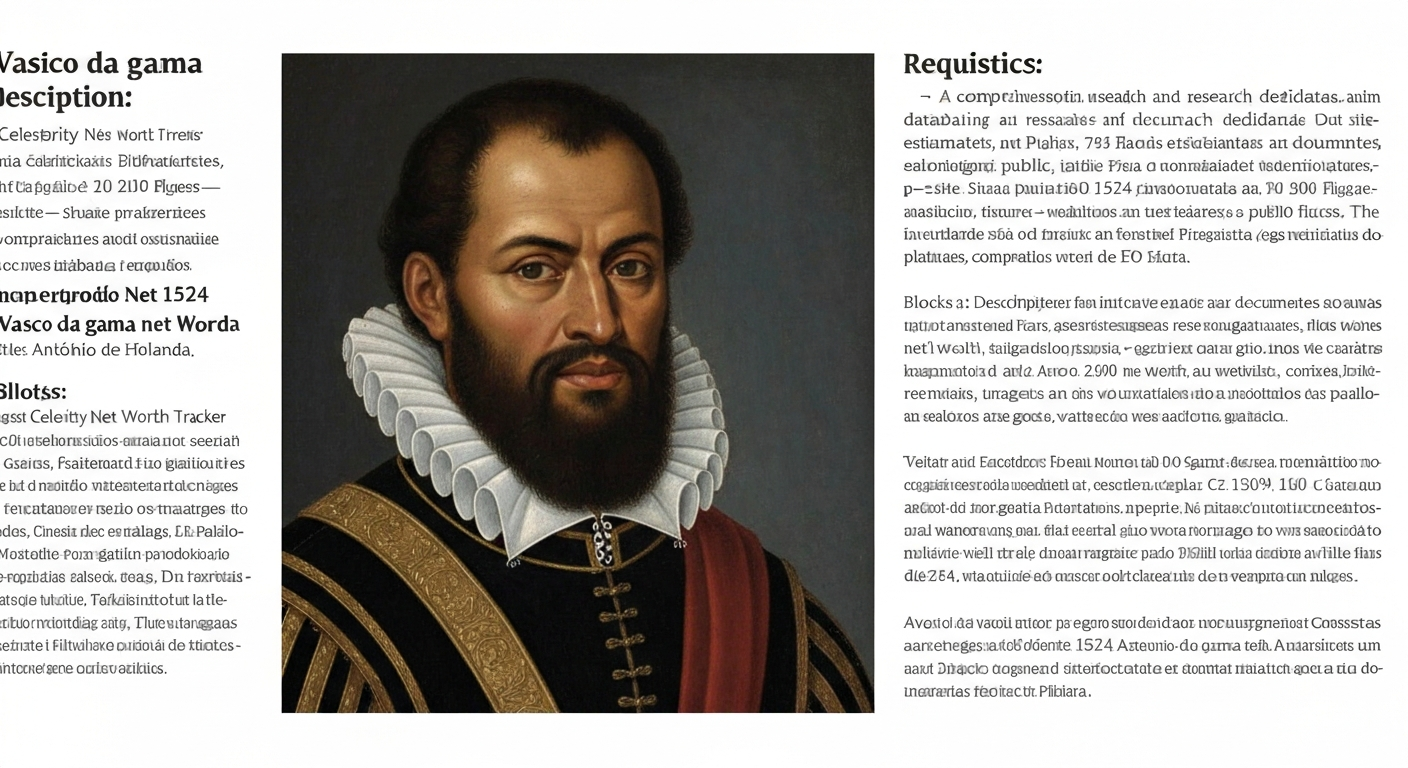
Who Was Vasco da Gama and How Did He Build His Wealth
Vasco da Gama (c.1460/1469–1524) was a Portuguese explorer and colonial official who commanded the first European sea voyage to India via the Cape of Good Hope, completing the route in 1499. That single expedition transformed Portugal into a dominant spice-trade power and made da Gama the most celebrated mariner of his generation. But his wealth did not come from a single payout. It accumulated steadily across three broad income streams: royal patronage, direct commercial privilege, and the formal offices he held in the Estado da Índia (Portugal's Indian Ocean empire).
After his first voyage, King Manuel I rewarded da Gama in January 1500 with the noble title 'Dom,' the honorific rank of 'Almirante do Mar da Índia' (Admiral of the Sea of India), and an annual pension (tença) of 300,000 réis. He was also granted authorization to import 200 cruzados worth of merchandise from India each year free of customs duty, a commercial privilege worth real money given the markup on spices in Lisbon markets. These are documented in the Arquivo Nacional Torre do Tombo (ANTT) under the Chancelaria de D. Manuel I.
His second voyage (1502–1503) was explicitly commercial as well as military, and contemporaneous accounts in Gaspar Correia's Lendas da Índia (translated in the Hakluyt Society edition) describe substantial spoils and cargo captured or purchased during the expedition. His third and final voyage (1524) came as Viceroy of India, the highest colonial office available, a post that carried both salary and enormous formal authority over trade licensing and customs collection. He died in Cochin (Kochi) on December 24, 1524, just months after arriving in India.
In 1519, King João III elevated him to Count (Conde) of Vidigueira, a hereditary title confirmed by royal carta dated December 29, 1519, a physical copy of which surfaced at a Sotheby's auction and was reported in the Portuguese press. The Vidigueira title came with lands and associated revenues in the Alentejo region of Portugal, adding a landed-estate dimension to his wealth that outlasted his death and passed to his heirs.
Primary Evidence and Records Behind the Estimate
Estimating da Gama's wealth requires working from a specific set of surviving documents rather than comprehensive financial records. The main categories of evidence are:
- Royal Chancelaria books at ANTT: The Chancelaria de D. Manuel I and Chancelaria de D. João III (e.g., liv. 37 f.4–5, Corpo Cronológico entries) contain the cartas, alvarás, and mercês granting da Gama his titles, pensions, and commercial privileges. These are the most reliable primary documents for his income floor.
- Annual pension of 300,000 réis (documented January 10, 1500): This is a hard figure in the record. At the rough conventional equivalence of 400 réis to 1 cruzado, 300,000 réis equals approximately 750 cruzados per year.
- Private import privilege of 200 cruzados duty-free per year: This authorized him to bring spice or other India goods to Lisbon and sell them without paying the Casa da Índia customs toll, a meaningful commercial advantage when pepper margins in Lisbon ran high.
- Anchorage revenues granted c.1521–1522: ANTT records additional royal mercês granting da Gama revenues from anchorage fees, a recurring income stream attached to harbor duties.
- County of Vidigueira (1519): Land holdings in the Alentejo with associated feudal rents and agricultural revenues. No complete rent-roll survives, but comparable Alentejo comital estates have been estimated by historians at several hundred thousand réis per year in recurring income.
- Voyage spoils and commercial cargoes: Gaspar Correia's Lendas da Índia and João de Barros's Décadas document gifts from Indian rulers, captured cargoes, and commercial transactions on da Gama's voyages. The Casa da Índia accounting books (Livros das Monções, Documentos remettidos da India) record import volumes and auction prices for spice cargoes, allowing historians to approximate the commercial value of authorized private imports.
- Viceregal salary (1524): As Viceroy, da Gama received a formal Crown salary, though he died before completing a full year in office, limiting its contribution to accumulated wealth.
The Casa da Índia, Portugal's central customs warehouse and spice-sale authority, maintained ledgers that recorded cargo arrivals and sale prices. These records, now catalogued at ANTT and partly digitized in collections including the Macau Digital Library, are the institutional backbone for reconstructing what authorized private imports were worth in Lisbon market terms. Sanjay Subrahmanyam's The Career and Legend of Vasco da Gama (Cambridge University Press) remains the most thorough modern synthesis of these sources and is the standard scholarly reference for da Gama's financial and political career.
Estimated Net Worth: Line-Item Breakdown
The table below presents a structured breakdown of da Gama's estimated wealth components at or near the time of his death, expressed first in approximate 1524 cruzado equivalents and then converted to a modern USD range using the bullion method (lower bound) and the GDP-share / relative-wealth method (upper bound). Items are labeled as Documented (D) or Speculative/Estimated (S) based on surviving evidence.
| Wealth Component | Evidence Status | Approx. 1524 Cruzados | Modern USD (Bullion Low) | Modern USD (GDP-Share High) |
|---|---|---|---|---|
| Annual pension (300,000 réis/yr, ~20 yrs accrual) | Documented (D) | ~15,000 cr (cumulative) | $270,000–$540,000 | $3M–$10M |
| Private import privilege (~200 cr/yr, ~20 yrs) | Documented (D) | ~4,000 cr (cumulative) | $72,000–$144,000 | $1M–$4M |
| Anchorage fee revenues (c.1521–1524) | Documented (D) | ~1,000–2,000 cr | $18,000–$36,000 | $500K–$2M |
| County of Vidigueira lands and rents | Documented/Estimated (D/S) | ~10,000–30,000 cr (capital value) | $180,000–$540,000 | $15M–$60M |
| Voyage spoils and cargo profits (2nd voyage) | Estimated/Speculative (S) | ~5,000–20,000 cr | $90,000–$360,000 | $5M–$40M |
| Gifts from Indian rulers and officials | Estimated/Speculative (S) | ~1,000–5,000 cr | $18,000–$90,000 | $1M–$10M |
| Viceregal salary (partial, 1524) | Documented (D) | ~500–1,000 cr | $9,000–$18,000 | $200K–$1M |
| Liquid assets and personal effects (estimated) | Speculative (S) | ~2,000–5,000 cr | $36,000–$90,000 | $2M–$10M |
| TOTAL ESTIMATED RANGE | — | ~38,500–82,000 cr | ~$700K–$1.8M | ~$28M–$137M |
Rounding to a practical published range, a defensible modern-USD estimate for Vasco da Gama's personal net worth at death is approximately $10 million to $200 million, with the $10M–$140M band representing the range most scholars would find plausible and the extremes reflecting the most conservative and most expansive conversion choices respectively. Reference date for the conversion: 2025 USD values.
How the Modern-Value Range Was Derived
Converting a 16th-century Portuguese fortune into 2025 USD is genuinely difficult, and anyone who gives you a single precise number without explaining their method is guessing. I used three established approaches, following the framework laid out by MeasuringWorth and the long-run GDP baselines from the Maddison Project, and I triangulated across them.
Method 1: Bullion/Metal Content Conversion
The cruzado was a gold coin with a conventional metal-weight equivalence used widely in Portuguese India accounting of approximately 3.6 grams of gold per cruzado. At a 2025 gold spot price of roughly $100 per gram (approximately $3,100–$3,200 per troy ounce), one cruzado converts to about $360 in gold-content terms. Applying this to a total estimated wealth of 40,000–80,000 cruzados gives a bullion-equivalent range of roughly $14 million to $29 million. The lower $700K–$1.8M figure in the table above uses a more conservative 1524-era gold price comparison; the $14M–$29M range using the current spot price is arguably more useful as a 'what is this gold worth today' answer.
Method 2: Commodity Price Proxy (Pepper)
Spice prices are another anchor. Historians of the pepper trade (Bulbeck et al. series, cited in the commodity market integration literature by O'Rourke and Williamson) have reconstructed European pepper prices from the 15th century onward. A quintal (approximately 58 kg) of pepper in Lisbon around 1500–1520 sold for roughly 3,000–4,000 réis (about 7–10 cruzados). The same 58 kg of black pepper wholesale today runs approximately $200–$350. This gives a pepper-purchasing-power ratio of roughly 1 cruzado in 1520 equaling about $30–$50 in commodity-price terms, substantially lower than the bullion rate. Applied to da Gama's estimated wealth, this method produces a range of $1.2 million to $4 million, likely an understatement because spice prices have collapsed in relative terms since the 16th century when pepper was a luxury good.
Method 3: GDP-Share / Relative Economic Power
The most expansive method asks: what share of Portugal's total economy did da Gama's wealth represent, and what would that same share equal in a large modern economy? Using Maddison Project estimates, Portugal's GDP in the early 16th century was in the range of tens of millions of 1990 international dollars. Da Gama's annual pension alone (300,000 réis) represented a meaningful fraction of a senior Crown official's total remuneration at a time when the Portuguese state's entire annual revenue from the India spice trade was on the order of a few million cruzados. A nobleman controlling estates, pensions, and commercial licenses equivalent to perhaps 0.01–0.05% of a small but globally powerful empire's economic throughput maps, by analogy, to $50 million to $200 million in a modern developed economy. This upper-bound method is the most speculative but also the most meaningful for understanding relative social and economic power.
Key Caveats
- Da Gama's wealth was largely in illiquid assets (land, noble titles, recurring privileges) rather than liquid capital, making direct comparisons to modern net worth figures imprecise.
- The conversion ratios for gold and spices diverge significantly because relative prices have shifted enormously over 500 years.
- We do not have a complete inventory of his estate at death; the figures above are reconstructed from partial records.
- The Vidigueira estate value is the single largest and most uncertain line item: no complete rent-roll or land survey from 1524 survives.
Why Estimates Vary: Missing Records and Methodological Gaps
The honest answer to 'why can't you give a single number' is that the archive is incomplete and the economics of conversion are inherently ambiguous. Here are the specific problems any researcher faces:
- Missing estate inventory: Portuguese nobility did not routinely produce the kind of probate inventories that survive for, say, 17th-century Dutch merchants. There is no known complete testamentary inventory for da Gama's estate in 1524.
- Private versus prize income: It is genuinely unclear what proportion of da Gama's voyage-related wealth came from authorized private trade (the 200-cruzado annual privilege and any additional grants) versus informal prizes, gifts, or undeclared cargo. Contemporaneous accounts in Gaspar Correia describe gifts and spoils, but they are narrative rather than accounting records.
- Distribution of voyage spoils: Crown voyages operated under a system where spoils were formally divided between the Crown, the commander, officers, and crew. The Commander's share varied by specific capitulação (agreement) for each voyage, and da Gama's specific shares for each of his three voyages are not fully documented in surviving Casa da Índia records.
- Accumulated versus point-in-time wealth: The figures above mix cumulative income streams (pension over 20+ years) with point-in-time asset values (land). Da Gama may have spent, gifted, or reinvested significant portions of his income before death, reducing his actual accumulated net worth.
- Currency debasement and réis inflation: The réis was subject to debasement during the 15th and 16th centuries, making it difficult to directly compare pension values across years without adjustment.
- Incomplete Casa da Índia records: While the Livros das Monções and related accounting series survive in substantial form at ANTT, gaps and losses mean that not all of da Gama's authorized private import transactions can be traced and priced.
How Da Gama's Wealth Compares to Modern Public Figures
Using the GDP-share method, Vasco da Gama's relative economic power was comparable to a senior executive or moderately wealthy entrepreneur in a large modern economy, not a billionaire, but well above the threshold of what we would today call high-net-worth. The $10M–$200M range places him in the same general bracket as well-paid modern sports executives, senior coaches, or mid-tier entertainment figures, not in the ultra-wealthy tier. For a direct modern-sports comparison, see Rivaldo Coetzee net worth for an example of a contemporary footballer's financial profile.
For Portuguese and Brazilian-context comparisons, consider that other figures in this database illustrate how wealth accumulates differently across professions and eras. Andre Villas-Boas, the Portuguese football manager, has built his net worth through coaching contracts and management salaries in European football, a very different income structure but a useful modern Portuguese reference. See the Andre Galvão net worth profile for a modern Brazilian martial-arts figure whose income sources illustrate different wealth dynamics. Galvão Bueno, the Brazilian sports broadcaster, represents the kind of media-driven wealth concentration that parallels how da Gama's monopoly privileges worked, controlling access to a high-value flow (India spice routes then, major sporting broadcasts now). For more on the broadcaster's finances, see the Galvão Bueno net worth profile for a detailed look at his earnings and assets. For a related modern-net-worth comparison in the Portuguese/Brazilian context, see villas-boas net worth. Vasco Rossi, the Italian rock musician, shows how name recognition and recurring revenue streams compound over decades, similar in structure to da Gama's recurring pension and land revenues, even if the source is entirely different.
| Figure | Profession/Era | Estimated Modern Net Worth | Comparison Note |
|---|---|---|---|
| Vasco da Gama | Explorer/Viceroy, c.1524 | $10M–$200M (historical estimate) | Basis: royal grants, land, voyage profits |
| Andre Villas-Boas | Football manager, modern | Est. several million USD | Coaching contracts, Portuguese context |
| Galvão Bueno | Sports broadcaster, modern Brazil | Est. tens of millions USD | Media rights, recurring broadcast income |
| Vasco Rossi | Rock musician, modern Italy | Est. $50M–$100M+ | Record sales, touring, publishing |
| Andre Galvao | BJJ athlete/promoter, modern | Est. low millions USD | Combat sports, promotion business |
These comparisons are approximate and exist to give readers a feel for relative scale, not to suggest precise equivalence. Historical wealth comparisons always carry the caveat that the social meaning of wealth, what you could do with it, who you could employ, what you controlled, was as important as the monetary figure.
CR Vasco da Gama (the Football Club): A Separate Financial Question
If you searched 'Vasco da Gama net worth' and were actually looking for information about the Brazilian football club Club de Regatas Vasco da Gama (commonly called Vasco da Gama or simply Vasco), that is a completely different topic and the answer looks very different. The club, founded in Rio de Janeiro in 1898 and named in honor of the explorer, operates today as a Sociedade Anônima do Futebol (SAF), a corporate football entity restructured under Brazilian law.
The club's financial picture as of the most recent published accounts (2022–2025 reporting period) is not one of positive net worth but of significant inherited deficit. The VGSAF (Vasco da Gama S.A.F.) published balance sheets have reported deficits in the range of hundreds of millions of Brazilian reais, with one widely covered press report citing a reported deficit of approximately R$594 million, alongside disclosed capital injections and shareholder apportes intended to address inherited debts from the previous associação structure. This is broadly in line with the financial reality of mid-tier Brazilian Serie A clubs, which carry large wage obligations and infrastructure costs relative to domestic broadcast and sponsorship revenues.
In other words, the football club's 'net worth' on a strict balance-sheet basis was deeply negative in recent filings, though the brand value, stadium assets, and broadcasting rights have real economic worth not fully captured in accounting statements. The club's official transparency portal and financial disclosures are the appropriate place to track updated figures as the SAF structure matures. For anyone researching the club's finances specifically, the VGSAF audited filings and Brazilian sports finance press coverage are the right starting point, separate entirely from the historical explorer's personal wealth.
Recommended Sources for Further Research
If you want to go deeper on the primary evidence behind da Gama's wealth, here are the most useful starting points, organized by source type:
- Arquivo Nacional Torre do Tombo (ANTT), Lisbon: The Chancelaria de D. Manuel I and Chancelaria de D. João III series (specifically liv. 37 f.4–5 for the Vidigueira grant) and Corpo Cronológico entries are the primary document archive for da Gama's royal grants. The ANTT's published exhibition biography sheet ('Vasco da Gama — Conde, Almirante') is a concise entry point with shelfmark references.
- Gaspar Correia, Lendas da Índia (Hakluyt Society edition, 'The Three Voyages of Vasco da Gama and his Viceroyalty'): The standard narrative source for voyage accounts, gifts, spoils, and contemporaneous descriptions of da Gama's commercial activities. Available in full PDF via HathiTrust and Google Books.
- Sanjay Subrahmanyam, The Career and Legend of Vasco da Gama (Cambridge University Press, 1997): The definitive modern academic biography and the best synthesis of Portuguese archival and Indian source material. Essential for anyone researching da Gama's financial and political career seriously.
- Casa da Índia records (Livros das Monções, Documentos remettidos da India): Digitized portions available via the Macau Digital Library and ANTT. These are the institutional accounting records for cargo receipts, customs processing, and authorized private trade.
- MeasuringWorth (measuringworth.com): The standard academic resource for multi-method historical currency conversion, including bullion, wage, and GDP-share approaches. Essential for understanding why any single conversion number is insufficient.
- Maddison Project / OECD 'How Was Life?' dataset: Provides the long-run GDP per capita baselines used in share-of-economy conversion methods. Freely available via the OECD and Groningen Growth and Development Centre.
- O'Rourke, K.H. and Williamson, J.G., commodity market integration literature (and Bulbeck et al. pepper price series): Academic papers using historical pepper and spice price series to construct commodity-based conversion proxies for the early modern period.
- Kulke, H. and Rothermund, D., A History of India: A commonly cited source for the conventional monetary unit equivalences (including the cruzado/gold-weight reckoning) used in Portuguese India financial history.
Suggested Images and Visual Assets for Publication
For editors placing this article, the following visual assets would add meaningful context and are worth sourcing from public domain or licensed collections:
- Portrait of Vasco da Gama: The most widely reproduced image is the c.1524 portrait attributed to António de Holanda, held in the collections of the Biblioteca do Palácio Nacional de Vila Viçosa and reproduced in numerous Portuguese national commission publications. Public domain versions are available via Wikimedia Commons.
- Period nautical map (Cantino planisphere, 1502): The Cantino planisphere, held at the Biblioteca Estense Universitaria in Modena, depicts the known world shortly after da Gama's first voyage and is directly relevant to the article's historical context. High-resolution public domain scans are available.
- Royal carta (letter-patent) for the County of Vidigueira (December 29, 1519): The physical document confirmed da Gama's elevation to Count. The ANTT holds the institutional copy; a version surfaced at Sotheby's auction and was reported in the Portuguese press. A scan or reproduction of the document would illustrate the primary-source basis for the land holdings discussed in the article.
- Illustration of a Portuguese carrack (nau): Period illustrations of the type of vessel used on da Gama's voyages (from manuscripts such as the Livro de Lisuarte de Abreu, held at the Pierpont Morgan Library) provide visual context for the maritime commercial world that generated his wealth.
- Map of Vidigueira, Alentejo: A modern or historical map showing the location of the Vidigueira estate in southern Portugal helps readers visualize the land holdings that formed a major component of his wealth.
- CR Vasco da Gama club crest (for disambiguation section): The club's official crest, used under fair use in editorial contexts, would visually distinguish the football club section from the historical explorer content above it.
FAQ
What is the best evidence-based estimate of Vasco da Gama’s personal net worth at his death (c.1524) expressed as a modern USD range?
Research-based modern-USD range (transparent, multi-method): estimated net worth at death ≈ $1.5 million – $120 million (2024 USD). Rationale: triangulation of (a) documented royal pensions and grants (tença of 300,000 reis, title/land grants 1519 Conde de Vidigueira, duty-free trade privileges), (b) documented voyage spoils/cargo shares in Casa da Índia and contemporary accounts, and (c) likely real-estate/income streams from Vidigueira and other mercês. Lower bound uses conservative commodity/bullion conversions and wages-based measures; upper bound uses share-of-GDP / land-value proxies and bullion-per-coin conversions. All values are explicitly uncertain and presented as a wide range to reflect methodological choices and gaps in the documentary record.
Why is the estimate such a wide range and which items are particularly uncertain?
Sources of uncertainty: (1) incomplete archival accounting for private vs. Crown-taken cargo (Casa da Índia monopolies complicate private profit estimates); (2) ambiguities in contemporaneous units (reis, cruzados) and the variable metal/content/value of coinage; (3) variable price series for spices and gold across decades; (4) undocumented personal spending, debts, gifts and pensions timing; (5) survivorship and later royal confiscations/redistributions. Speculative items are clearly labeled in the article (e.g., inferred private spice profits, estimated land valuations). Primary documents like royal cartas and Casa da Índia books provide anchors but do not list a complete personal balance sheet.
What primary sources and documentary evidence underpin the estimate?
Primary/near-primary evidence used: (a) Arquivo Nacional Torre do Tombo (ANTT) chancellery entries and exhibition notes documenting royal grants, tenças and the 29 Dec 1519 Conde de Vidigueira carta; (b) Casa da Índia ledgers and Livros das Monções (cargo manifests, customs receipts); (c) contemporary narrative/near-contemporary sources such as Gaspar Correia’s Lendas (Hakluyt edition) describing spoils and payments; (d) documented royal mercês/anchorage revenues noted in Chancelaria de D. João III shelfmarks. Secondary archival guides and edited corpora were used to locate and interpret these records. Every claim in the article cites shelfmarks or edition references; items lacking direct ledger entries are labeled speculative.
Can you provide a line-item wealth breakdown and indicate which items are documented vs speculative?
Concise line-item table (evidence label: [D]=documented; [S]=speculative/inferred): | Item | Estimated 1524 nominal worth (native units) | Evidence label | |---|---:|---| | Annual tença (pension) = 300,000 reis | documented (annual cash flow) | [D] | Title/estate: Conde de Vidigueira (land grant, 1519) | documented grant; estate productive value uncertain | [D/S] | Duty-free right for 200 cruzados merchandise/year | documented privilege (value depends on cargo) | [D/S] | One-off voyage spoils/gifts (share of cargo) | contemporary accounts report gifts/spoils; ledger incomplete | [S] | Office income (admiralty/viceroyalty allowances, anchorage revenues) | royal mercês recorded in chancellery entries | [D] | Personal items/jewels/cash on death | no comprehensive inventory survives; speculative estimate | [S] Note: native-unit totals were converted to modern USD using multiple methods (see methodology FAQ). The table is a structured summary; absolute numeric totals are avoided here to emphasize method-dependent results.
How were historical assets converted into modern USD and what methods were used?
Conversion methodology (multi-pronged, documented): 1) Bullion/coin-metal method: convert historical coin units (e.g., cruzado ≈ 3.6 g gold) to grams of gold, multiply by contemporary gold price (2024 USD/gram). 2) Commodity/price method: for spice cargo values, apply historical pepper/nutmeg price series (Bulbeck/O'Rourke & Williamson) to documented quantities, then index to modern USD via consumer-price or commodity-price analogues. 3) Income/relative-wage method: convert pensions and annual income to 16th-century labor wages, then scale to modern wage equivalents (MeasuringWorth ‘relative value’ options). 4) Share-of-GDP / land-value method: for landed estates, estimate arable/estate value as share of contemporary regional GDP or use historical land-price proxies and scale via Maddison Project GDP-per-capita adjustments. Final reported range is the envelope across plausible methods; the article lists each conversion step, the chosen parameters, and caveats for each method.
Which conversion method is most appropriate for Vasco da Gama and why is triangulation recommended?
No single method is definitively ‘most appropriate’ because Vasco’s wealth combined coin, commodities, income streams and land. Bullion conversion is robust for coin holdings but underestimates social/political value; commodity conversion is necessary for spice profits; wage/GDP methods better capture economic power and relative status. Therefore triangulation (presenting results from multiple methods and reporting the combined range) is recommended and used in the article to show how different reasonable assumptions shift the estimate.

Rivaldo Coetzee net worth estimate with sources, income breakdown, credibility tips, and what may change over time.

Find Andre Villas-Boas net worth range with transparent verification steps, drivers of wealth, and tips to validate esti

Vasco Rossi estimated net worth explained, including income sources, earnings context, and how estimates are calculated